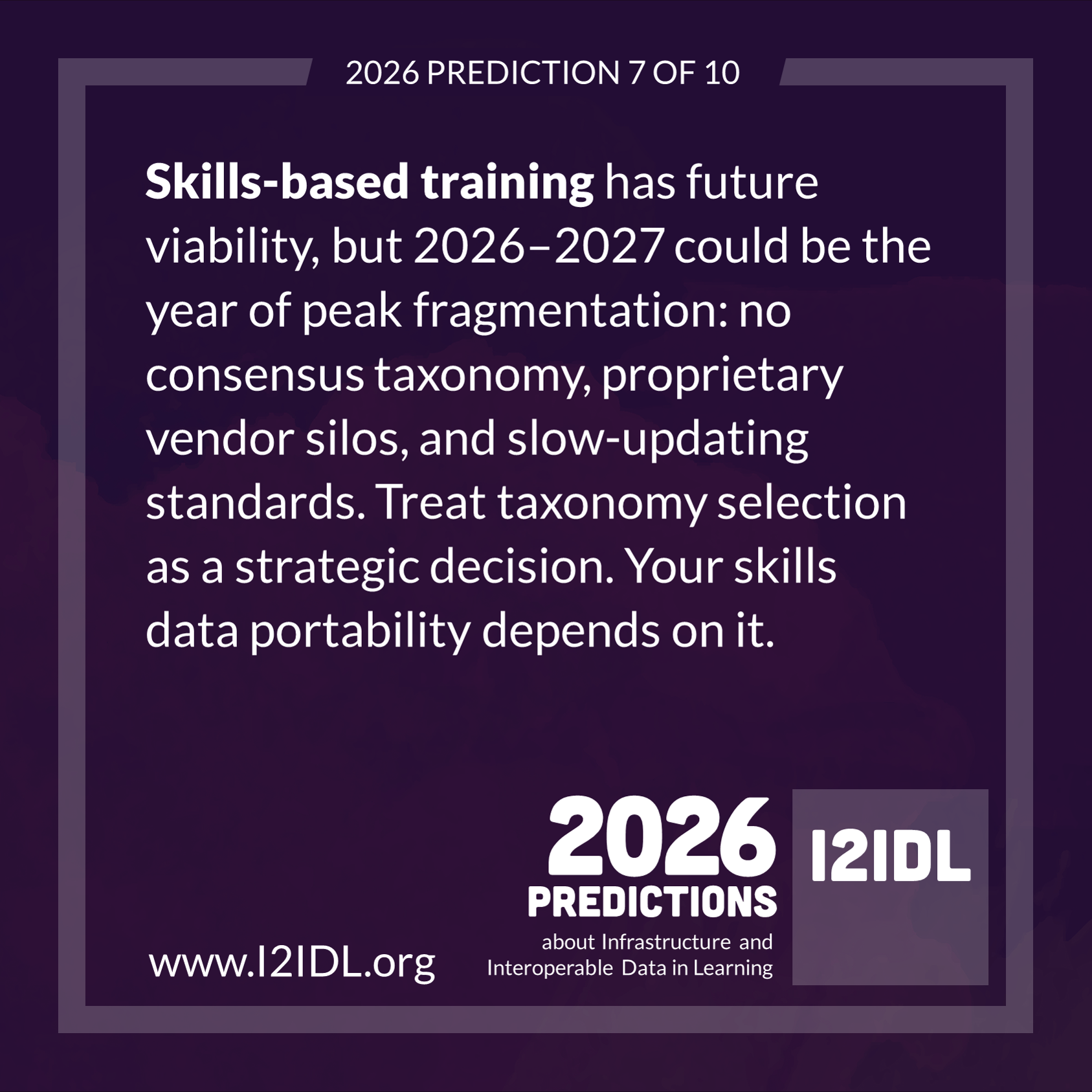
Continuing on I2IDL’s top ten predictions for learning technologies and data infrastructure in 2026, our seventh prediction is that despite high interest from business and government, we expect to see continued challenges in implementing “skills-based” training and workforce paradigms.
(ICYMI, check out Prediction #6 about workforce training.)
Confidence Level: 4/5 ★★★★☆
“Skills-based organization” has become the hottest phrase in HR and L&D strategy. Reports claim that 85% of companies used skills-based hiring in 2025, and at least one firm has coined the phrase “skills as system architecture.” But genuine uptake still faces practical barriers.
As detailed in a Harvard Business School and Burning Glass Institute 2024 report, many employers claim to use skills, but about 45% of firms do so in name only, and nearly 20% of firms that try skills-based hiring later backslide to traditional methods. Largely, the problem isn’t motivation. Business and government are hungry for a skills-based solution, but the community needs to resolve some friction points, such as a lack of trusted skills-first products and siloed skills data.
We also haven’t reached consensus on how “skills” should be defined or which taxonomy should govern. Lightcast (formerly EMSI/Burning Glass) dominates labor market analytics with its proprietary skills library. O*NET remains the U.S. federal standard for occupational data but updates slowly and maps awkwardly to fast-changing technical skills. ESCO serves as the European standard, with different granularity and structure than its American counterparts. Major platform vendors (Workday, Cornerstone, SAP, LinkedIn) each maintain proprietary taxonomies optimized for their ecosystems (albeit some with third-party integrations). Meanwhile, industry-specific standards (such as NICE for cybersecurity or ATD’s model for talent development professionals) serve vertical communities but don’t interoperate horizontally.
To further complicate things, the skills required for modern jobs can—and increasingly will—be a moving target. Just as today’s auto mechanics need new proficiencies in servicing onboard technology and electric vehicles, the nature of many professions is changing due to AI automation and other macroeconomic forces. Current skills taxonomies built on mining historical job postings aren’t likely to reflect the realities of a contemporary talent marketplace.
Standards bodies and infrastructure organizations (IEEE, HR Open Standards, Credential Engine, 1EdTech) have interoperability standards for linking skills taxonomy metadata, but adoption is slow. The most probable outcome is continued coexistence of multiple taxonomies, with organizations forced to maintain mappings between them or commit to a single vendor’s ecosystem. It’s also possible that public good data utilities, such as the T3 Innovation Network’s New Data Paradigm, could emerge to bridge open skills taxonomies, automatically translating across technical standards.
The bottom line is that more work is needed to scale skills-based HR and L&D into widespread practice. This work is happening, but we anticipate that 2026 and 2027 will be peak fragmentation years, with consolidation pressure building but no clear resolution until later in the decade, once the market coalesces around a smaller set of viable frameworks and the gap between genuine skills-based practices and superficial rebranding becomes harder to ignore.
For organizations pursuing skills-based strategies, this fragmentation creates real pain. Skills defined in your LXP won’t map cleanly to your HR Information System. Skills defined for job-role profiles probably won’t be granular enough for learning measurement and feedback. Credentials earned on one platform won’t yet be recognized by another. We’re confident that skills-based HR and L&D are the future, but the promise of skills data flowing seamlessly from learning systems to talent marketplaces to workforce planning tools isn’t a reality—yet.
So what? For organizations embarking on skills-based transformation, taxonomy selection is a strategic decision with long-term implications; don’t treat it as a technical detail to be delegated. Ask vendors hard questions about taxonomy openness: Can you export skills data in open formats? Can you map to external frameworks? What happens to your skills data if you switch platforms? How do you maintain the timeliness of the skills in your taxonomy, how granular are they, and how are they validated? For the standards community, skills taxonomy interoperability is arguably the most consequential unsolved problem in learning and workforce data. IEEE 1484.20.3 (Sharable Competency Definitions) provides a container format for expressing competency definitions, but interoperability still requires semantic alignment that the standard doesn’t address. Whoever cracks that problem—whether through AI-powered mapping, federated identity for skills, or industry consortium agreement—will hold significant influence over the next decade’s workforce infrastructure.