Beyond the LMS: The Future of Learning Infrastructure
Check out the video recap: A conversation between Shelly Blake-Plock and the xAPI Collective about IEEE data standards, concerns about AI, the role of I2IDL, and a host of other things. Check out the video for the full conversation.
Prediction #10: Total Learning Architecture maturity will advance significantly
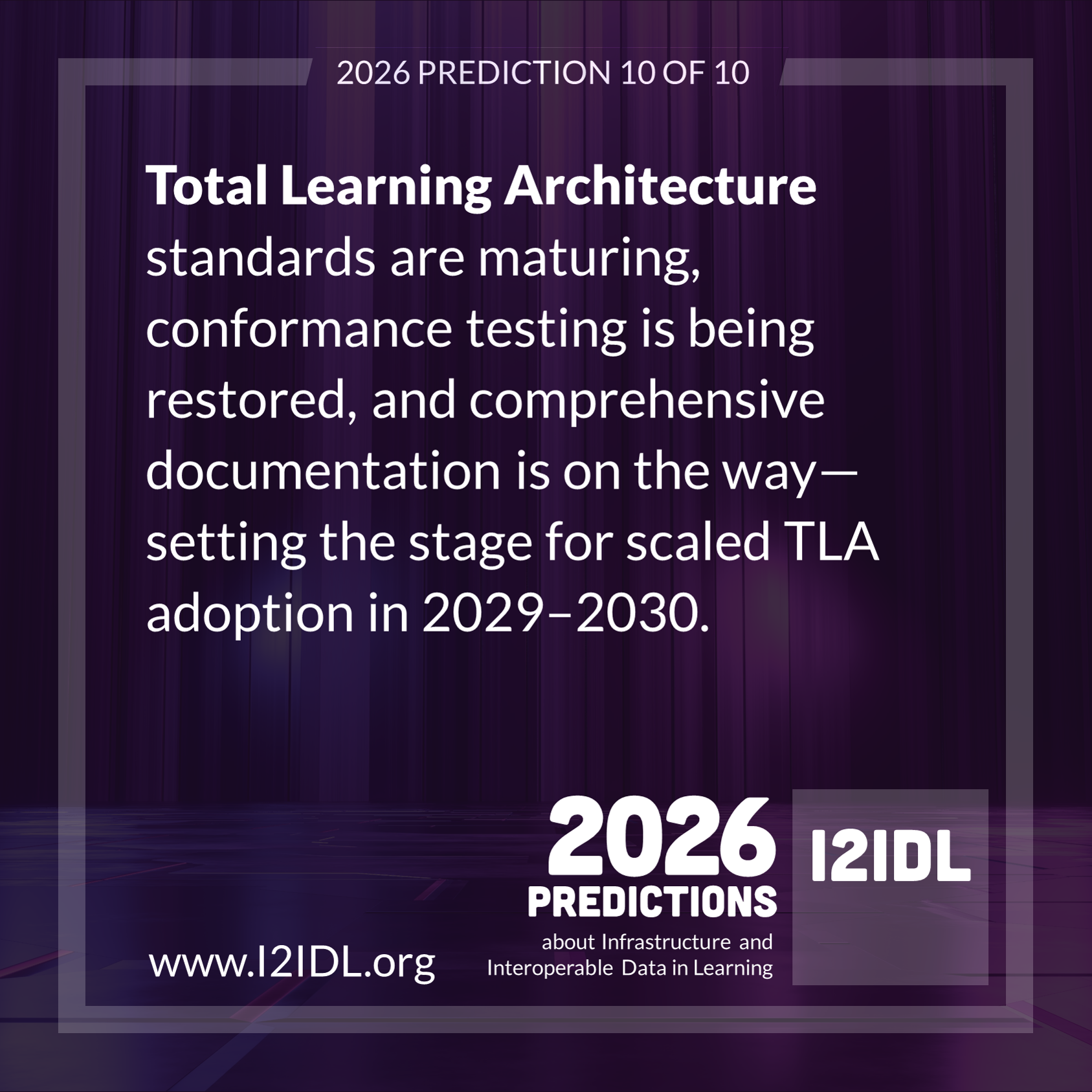
Prediction 10 of 10: The Total Learning Architecture (TLA) has been in development for over a decade, providing a standards-based, software-validated interoperable data architecture for enterprise learning ecosystems. But until recently, the TLA has been a vision, largely implemented in research laboratories rather than in real-world production pipelines. In 2026, the TLA ecosystem will hit several meaningful milestones. It will be better documented, better supported, and more implementable than ever before.
Webinar Invitation: Building the Infrastructure for Interoperable Learning Data
If your organization invests in workforce development, education technology, or AI-enabled learning systems, this conversation is for you.
Prediction #9: Data privacy solutions, such as Self-Sovereign Identity, move into the Early Adopter phase
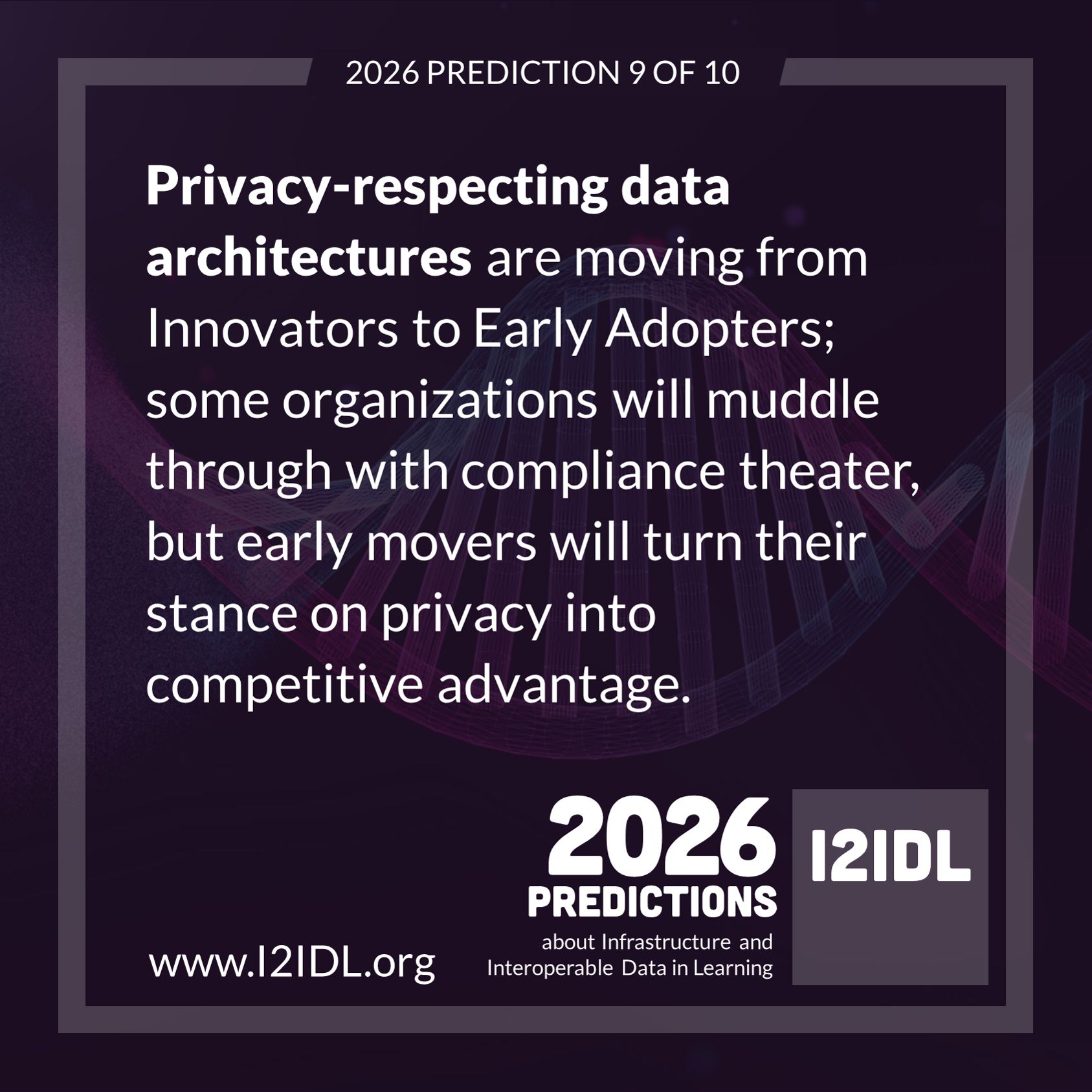
Prediction 9 of 10: The regulatory pressure for learning data privacy is growing. At the same time, organizations want richer learning analytics. These ambitions increasingly conflict with privacy constraints that limit data collection, retention, and cross-system sharing. Emerging approaches offer a path forward. Privacy-respecting data architectures are moving from Innovators to Early Adopters; some organizations will muddle through with compliance theater, but early movers will turn their stance on privacy into competitive advantage.
Prediction #8: Verifiable Credentials and Digital Wallets will expand in pilots, with policy mandates as potential accelerants
Prediction 8 of 10: The infrastructure for Verifiable Credentials is maturing rapidly. W3C published Verifiable Credentials 2.0 as a full Recommendation in May 2025. Open Badges 3.0 and the Comprehensive Learner Record 2.0 are finalized and VC-aligned. The T3 Innovation Network's Learning and Employment Record work continues advancing, with open-source tools via LinkedCreds and a new LER Resume Standard. The EU Digital Identity Wallet has a 2026 operational target. In 2026, we expect significant pilot expansion.

Seeking Interest: the I2IDL Higher Education Council
The convergence of AI-enabled education, newly ratified international data standards, and growing demand for interoperable workforce and credentialing ecosystems has created an unprecedented opening for universities to help shape the foundational data architecture of modern learning.
The question is no longer whether learning systems will become interoperable and AI-integrated.
The question is: Who will define the infrastructure?
The I2IDL Higher Education Council is where that work begins.
Prediction #7: “Skills-based” ambitions will continue, but expect market fragmentation while semantic data challenges get resolved
Prediction 7 of 10: “Skills-based” ambitions will continue, but expect market fragmentation while semantic data challenges get resolved. “Skills-based organization” has become the hottest phrase in HR and L&D strategy. Reports claim that 85% of companies used skills-based hiring in 2025, and at least one firm has coined the phrase “skills as system architecture.” But genuine uptake still faces practical barriers.
Prediction #6: AI automation will disrupt traditional learning pathways and expose content obsolescence
AI automation will remove the “bottom rung” of many career ladders and rapidly change large portions of other jobs and their associated training. Expect broken learning pathways and accelerated obsolescence of workforce training content.
Prediction #5: Learning Engineering will gain institutional momentum, especially in military and academic sectors
Learning Engineering will gain (even more) institutional momentum in 2026, moving from an emerging discipline to an operational capability, especially in military and academic sectors where evidence-based, data-informed learning systems are becoming mission-critical.
Prediction #4: The “Learning Tech Stack” will enter the strategic conversation
In 2026, learning tech stack thinking will enter the mainstream, shifting learning platforms away from closed system silos and toward composable ecosystems of content, analytics, and adaptive services connected through open APIs.
Prediction #3: Automated metadata generation will emerge as a strategic capability—and potentially a standalone business
As interoperable learning platforms scale, metadata becomes a bottleneck. In 2026, AI-generated metadata will emerge as core learning infrastructure, accelerating discoverability and personalization while increasing demand for validation, standards alignment, and trustworthy “Content Metadata as a Service.”

Mention of I2IDL in OLDaily
Check out today’s mention of the Institute for Infrastructure and Interoperable Data in Learning in OLDaily.
Webinar Recap: 29 January 2026, Part I
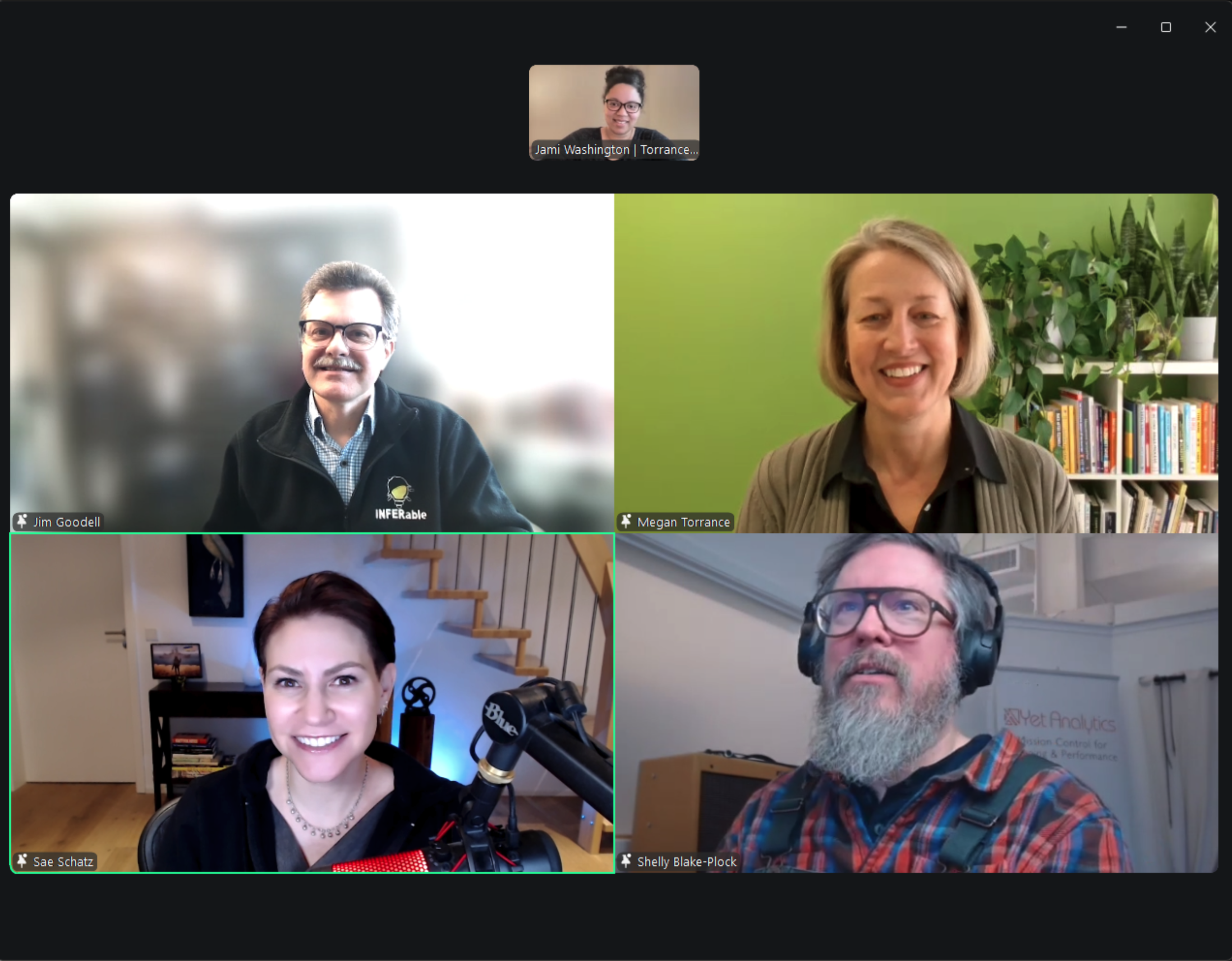
Thank you to everyone who joined us for the Infrastructure and Interoperable Data in Learning’s first webinar. This is Part I of two parts documenting the entire conversation.
![Thriving in the Age of Acceleration [at ASU LERN 2026]](https://images.squarespace-cdn.com/content/v1/69386833ec5390068dddf860/1770137440168-B51VKRVA61K5SRGUT3VA/unsplash-image-WmdpCOQZk4g.jpg)
Thriving in the Age of Acceleration [at ASU LERN 2026]
Sae Schatz is at ASU’s LERN 2026 Convening where she is giving a keynote addressing:
“three defining characteristics reshaping how we work, live, and learn, and it provides a forward-looking framework for how Learning Engineering principles can help us build systems that match the pace of change.”
![Data Interoperability in Enterprise Learning Ecosystems [Purdue University Online]](https://images.squarespace-cdn.com/content/v1/69386833ec5390068dddf860/1770136391722-0QOHVVHUVL5UUE0A83LG/unsplash-image-T9rKvI3N0NM.jpg)
Data Interoperability in Enterprise Learning Ecosystems [Purdue University Online]
I2IDL president Shelly Blake-Plock will be presenting on Data Interoperability as part of the Virtual AI and Data Science Speaker Series hosted by the Purdue University Online Capstone Experience.

Announcing the Inaugural I2IDL Technical Steering Committee
I2IDL relies on the Technical Steering Committee to advise on matters of technical governance and to ensure equity in the open source nature of the work of the institute. The committee is responsible for the institute’s open source policy and for consensus-first advisory on matters of technical conformance testing.
![I2IDL, xAPI and the Total Learning Architecture: Why Infrastructure Matters More Than Ever [from xAPI.com.au]](https://images.squarespace-cdn.com/content/v1/69386833ec5390068dddf860/1769788802943-KRXGN4SSA1F08SYLCBSF/unsplash-image-Lk-nu_hX6ms.jpg)
I2IDL, xAPI and the Total Learning Architecture: Why Infrastructure Matters More Than Ever [from xAPI.com.au]
“One thing that has become increasingly clear over the years is this: learning data does not fail because of a lack of ideas. It fails because of weak infrastructure and poor interoperability. That is why the launch of the Institute for Infrastructure and Interoperable Data in Learning (I2IDL) really matters.”

Last Call: Be Sure to Register for our First Free Public Webinar
Learn why interoperability matters for your organization's learning and workforce investments. And learn how to become a part of I2IDL’s community.

I2IDL: Status Update
The I2IDL website went live 35 days ago. The idea of I2IDL itself only came to be formed about two weeks prior to that. It was an idea that came out of a bit of a crisis in the learning technology community which was discussed in our inaugural white paper released on 15 Dec 2025.
Since then, we’ve talked to hundreds of you. We’ve talked to people in government both in the United States and abroad and we are still learning about how the changes at ADL are affecting you both in terms of technological guidance and partnership and in terms of “what next”. We’ve talked to industry who were (and in many cases still are) unclear on what this all means for xAPI, Learning Record Stores, and the Total Learning Architecture. We’ve also gotten a tremendous amount of support from across industry, among commercial vendors—many of whom are competitive with one another—and their stakeholders, and through channels of service providers and learning technology consultants. From talking to the largest open source learning software vendor in the world to talking to a grad student just thinking of starting her own business, we’ve been listening.
Prediction #2: Data quality tooling for xAPI will become a priority as learning technologies increasingly share data
As more tools and organizations share their xAPI data around, the question of data quality becomes (even more) urgent. A malformed statement, a non-conformant xAPI Profile implementation, or low-fidelity activity data no longer “just” create local problems; now flawed data can propagate through the network, degrading analytics and undermining trust across the digital landscape.