Prediction #6: AI automation will disrupt traditional learning pathways and expose content obsolescence
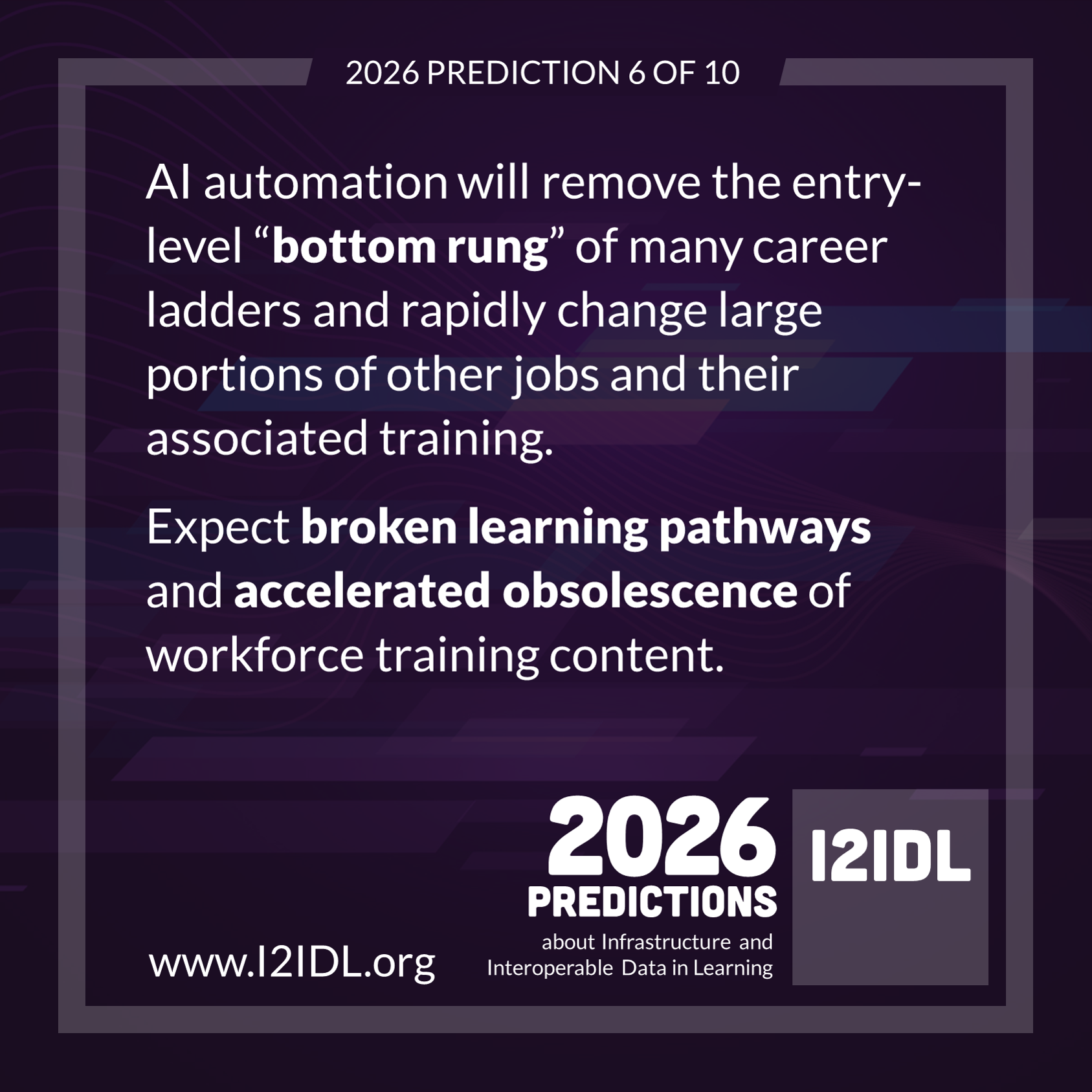
Continuing on I2IDL’s top ten predictions for learning technologies and data infrastructure in 2026, our sixth prediction is that AI will disrupt workforce development, especially for early-career professionals.
(ICYMI, check out Prediction #5 about learning engineering.)
Confidence Level: 5/5 ★★★★★
Entry-level jobs are disappearing, and highly AI-exposed entry roles (with many automatable tasks) have declined more than 40% since 2023.
Entry-level roles have traditionally served as training grounds, the “first rung” where junior employees develop foundational skills. As these rungs disappear, the experiential learning that once happened naturally on the job must now be constructed deliberately: through simulations, AI-powered practice environments, structured projects, and mentorship programs that replicate developmental experiences. Most learning systems aren’t ready for this shift. They’re built to track course completions, not capability development through practice and simulation. They assume learners will acquire foundational applied skills on the job, but when the “on the job” rung disappears, the entire progression model begins to teeter.
Simultaneously, AI automation is rendering today’s workforce development content obsolete at unprecedented speed. Content designed to teach now-automated tasks (data entry procedures, routine reconciliations, standard document processing) are misaligned. But most schools and businesses lack the metadata infrastructure to identify which content is affected. Without granular mapping from content to tasks to roles, L&D teams can’t systematically audit their libraries. They’ll likely discover obsolescence anecdotally, one frustrated learner at a time, rather than proactively retiring stale material.
We predict that 2026–2027 will surface early symptoms: new hires who completed onboarding but can’t perform because the tasks they trained for no longer exist in their roles; content libraries where 20-30% of material addresses automated workflows; learning pathways that assume prerequisites learners can no longer acquire through entry-level experience. By 2028, organizations that haven’t invested in content-to-task metadata and simulation-based capability development will face expensive remediation.
So what? For L&D leaders, audit your content-to-task mappings now, before obsolescence compounds. Identify which training assumes entry-level job experience as a prerequisite, and begin designing alternatives. Invest in simulation and practice environments that capture competency evidence, not just completion data. For learning technology vendors, this is an opportunity to differentiate. Systems that support granular content-task-role metadata, track capability development through experiential modalities, and surface obsolescence risks proactively will command premium positioning as the problem becomes visible. For the standards community, the “missing rung” problem reinforces urgency around several concurrent challenges: skills taxonomies need faster update mechanisms to reflect task-level automation; xAPI and experiential data standards become critical for capturing learning that happens outside courses; competency frameworks must support capability assertions that previously came implicitly from job experience. The assumption that “time in role” equals skill development is breaking down. Learning data infrastructure needs to fill the gap.