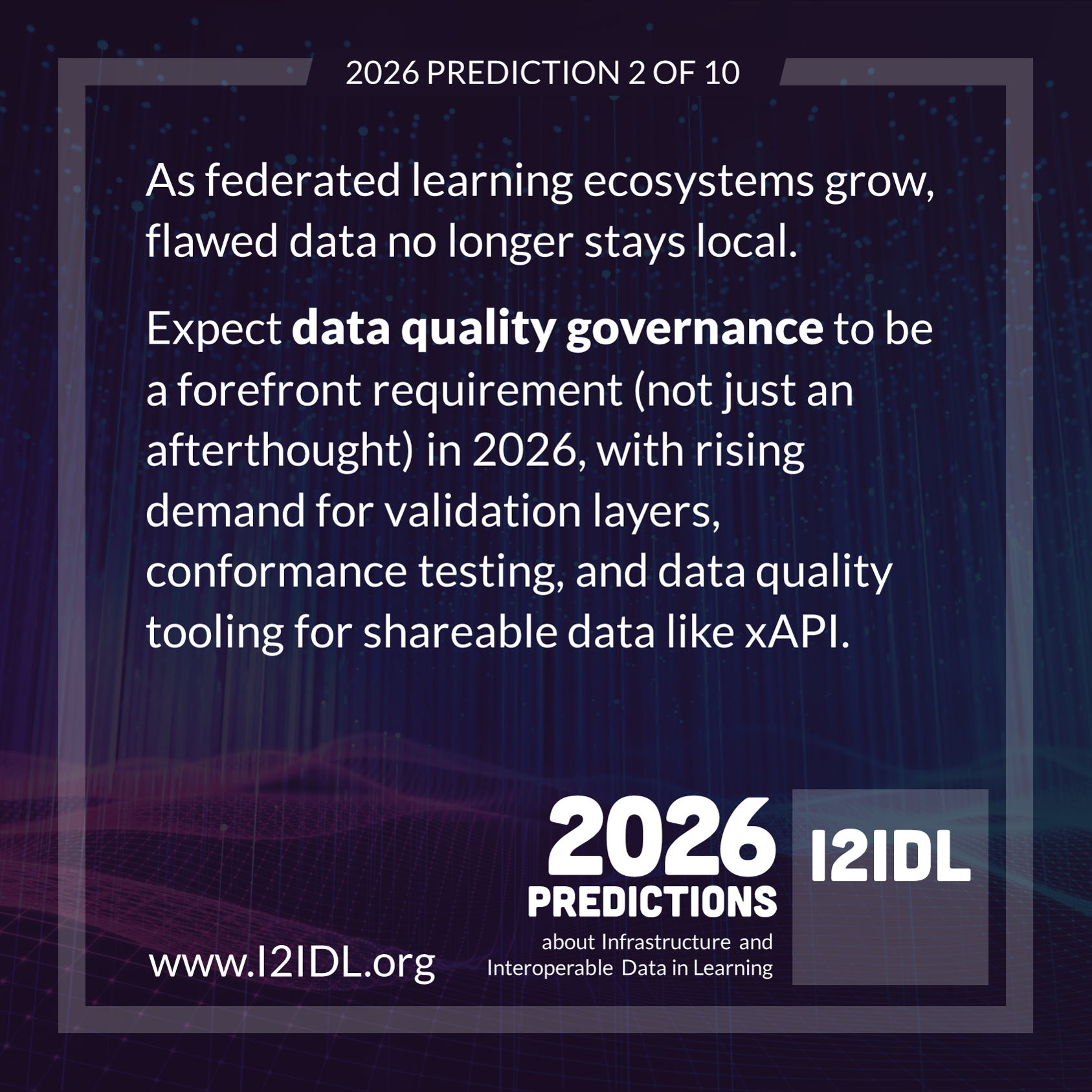
Continuing on I2IDL’s top ten predictions for learning technologies and data infrastructure in 2026, our second prediction is that data quality tooling for xAPI will become a priority as learning technologies increasingly share data.
(ICYMI, check out Prediction #1 about Learning Slop)
Confidence Level: 3/5 ★★★☆☆
We’re already seeing the emergence of federated learning technologies. (“Federation” refers to different, independent systems working together, sharing data across boundaries.) These kinds of “ecosystems” rely on standards, for data formats, Application Programming Interfaces (APIs), processes, and so on. In the learning technology sector, one of the increasingly popular “data highways” involves Experience API (xAPI) data, which captures user interactions and performance outcomes.
As more tools and organizations share their xAPI data around, the question of data quality becomes (even more) urgent. A malformed statement, a non-conformant xAPI Profile implementation, or low-fidelity activity data no longer “just” create local problems; now flawed data can propagate through the network, degrading analytics and undermining trust across the digital landscape.
In August 2025, NATO recognized the risk of poor quality data within a federated network and subsequently published the Data Quality Framework for the Alliance. It’s a governance document establishing shared principles and management processes for data quality across organizations (and nations), with particular emphasis on ensuring quality data for AI training and data-driven decision-making. Similar data quality frameworks, such as from the UK government or EU’s Data Union Strategy, similarly target the “fuel” (that is, data) in AI-enabled digital ecosystems.
In general, these data quality frameworks are general-purpose—not specific to training, education, or other personnel data—but the same principles apply to the L&D sector too, whether we’re talking about K-16, higher-education, corporate L&D, or beyond. These broad-reaching frameworks really emphasize the importance of high-quality data.
The need is clear. So in 2026, I2IDL anticipates increased attention on data quality tooling for xAPI ecosystems: conformance test suites restored and extended, validation layers added to Learning Record Stores (LRSs), and early experimentation with automated flagging of non-conformant data. Whether this coalesces into productized “Data Quality as a Service” offerings remains uncertain; the market is nascent and the infrastructure still stabilizing. But we see the conversation shifting from “can we collect xAPI data?” to “can we trust the xAPI data we’re collecting?” For organizations building federated learning networks, we predict that data quality governance will be a forefront requirement (rather than an afterthought) this year and beyond.
So what? For standards bodies and infrastructure providers, this is a call to prioritize not just conformance testing but ongoing data quality monitoring as a core capability. It’s also a call to develop new standards that integrate semantic quality standards that incorporate learning analytics principles, learning sciences best practices, and/or skills recognition standards like those found in some Verifiable Credential payloads. For organizations implementing xAPI, the message is to build validation into your data pipelines now. Don’t wait until your LRS is full of bad statements. For the learning engineering community, data quality literacy needs to be part of your job, for instance, understanding what makes xAPI data trustworthy and how to diagnose problems when analytics don’t behave as expected.