Prediction #3: Automated metadata generation will emerge as a strategic capability—and potentially a standalone business
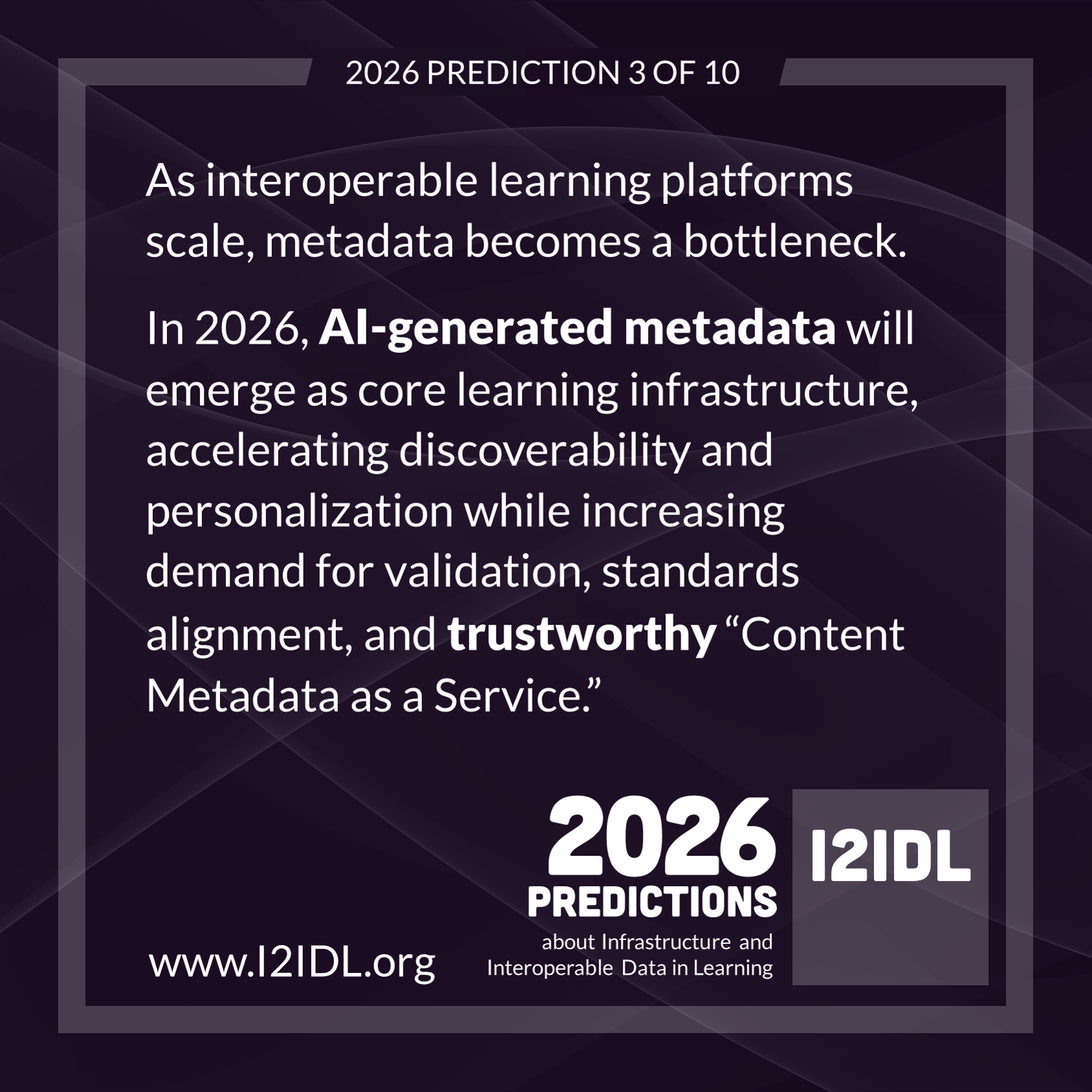
Continuing on I2IDL’s top ten predictions for learning technologies and data infrastructure in 2026, our third prediction is that automated metadata generation will be an emerging area of both opportunity and failure.
(ICYMI, check out Prediction #2 about Data Quality)
Confidence Level: 3/5 ★★★☆☆
The promise of a lifelong learning digital ecosystem relies on excellent search capabilities (discoverability), smarter recommendations, functional adaptive learning, credible skills analytics, and all of these features require high-quality metadata. This means rich metadata for every object: difficulty level, duration estimates, topic classification, skills and competencies addressed, learning objectives, prerequisite relationships, accessibility attributes, audience relevance, and more. Unfortunately, writing metadata by (human) hand hasn’t really worked.
The economics of manual content tagging are broken. Most organizations tag poorly or not at all, which is why content discovery, personalization, and analytics consistently underperform. The bottleneck isn’t technology; it’s the human labor required to tag thousands of learning objects against dozens of metadata dimensions.
AI is poised to break this bottleneck. Large Language Models (LLMs) can now ingest content—video, documents, interactive modules, test banks—and generate reasonable metadata across multiple dimensions: suggesting competency alignments, estimating difficulty and duration, mapping to taxonomies, identifying prerequisites, and flagging accessibility gaps.
In 2026, I2IDL predicts that Learning Management System (LMS) and Learning Experience Platform (LXP) vendors will ship more AI-assisted metadata features as standard capabilities. Further, we may even see “Content Metadata as a Service,” standalone algorithmic offerings that ingest content libraries and return enriched, standards-aligned metadata via API. (This “CMaaS” approach fits well with the composable “Learning Tech Stack” model discussed in prediction #4.) The business case is compelling. Organizations with legacy content libraries could enrich thousands of objects in weeks rather than years. Content publishers could deliver pre-tagged assets that integrate seamlessly with customer systems.
Of course, there’s also a caution: metadata slop (as outlined in prediction #1). Poor quality AI hallucinations and overgeneralizations could substantially degrade ecosystem performance, and sloppy metadata may be particularly insidious, since it’s rarely reviewed carefully with human eyes. So, it will be important to ensure automated metadata software is highly reliable and valid, and that it connects to broad standards and published frameworks (such as standardized formats, skill taxonomies, job descriptions). These tools should also have feedback loops, such as using learner interaction data to verify the accuracy of LLM-generated metadata.
So what? For vendors, AI-assisted metadata is becoming a competitive requirement, not a differentiator—invest now or fall behind. For organizations with large content libraries, this represents an opportunity to unlock value from existing assets: explore AI-powered enrichment tools and budget for metadata remediation projects. For the standards community, automated metadata generation raises alignment questions: How do AI-generated tags map to IEEE 2881 Learning Metadata (published October 2025) or machine-readable competency frameworks? What confidence levels should be captured? How should machine-generated metadata be distinguished from (and link to) human-validated metadata in downstream systems? For entrepreneurs, “Content Metadata as a Service” is a greenfield opportunity; the problem is universal, the technology is ready, and the market lacks specialized solutions.