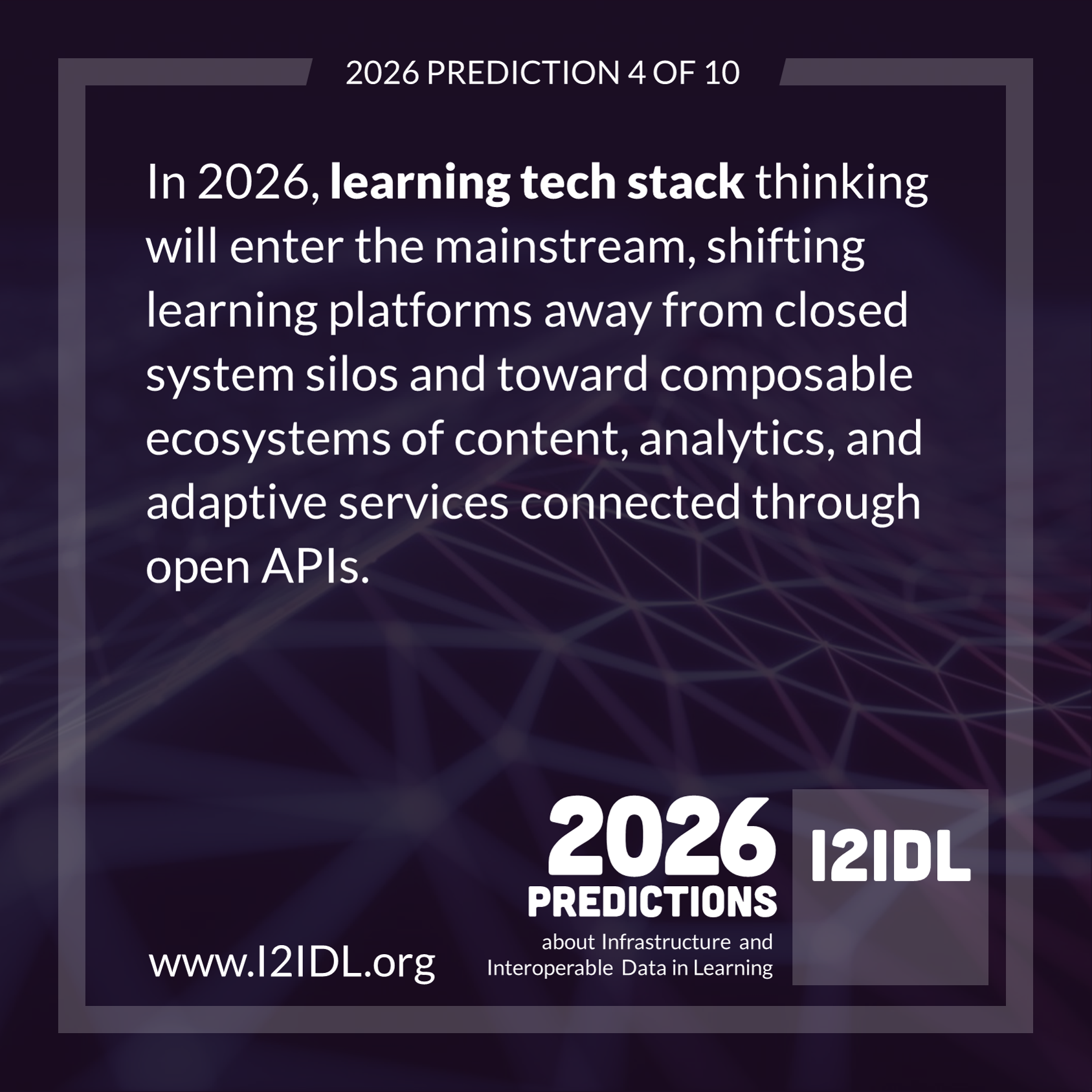
Continuing on I2IDL’s top ten predictions for learning technologies and data infrastructure in 2026, our fourth prediction is that the “Learning Tech Stack” enters the strategic conversation.
(ICYMI, check out Prediction #3 about automated metadata generation.)
Confidence Level: 4/5 ★★★★☆
A tech stack is the complete set of technologies, tools, and software used to build and run a digital system. Think of it as the collection of building materials, architectural plans, and construction tools needed to build a house. Modern software teams assemble tech stacks from best-of-breed software services (for example, Stripe for payments, Twilio for communications, Datadog for observability), with each service communicating via standardized APIs.
In 2026, I2IDL predicts that this architectural pattern will gain visibility as a model for learning technology. We’re referring to the idea that analytics engines, personalization algorithms, and adaptive services could exist as standalone microservices plugged into any learning ecosystem, rather than locked within monolithic platforms. Expect the concept to surface in standards body discussions, conference presentations, and vendor positioning, particularly among those building on a Total Learning Architecture (TLA)–enabled infrastructure. Forward-thinking organizations will begin asking vendors pointed questions about API access to analytics and whether personalization capabilities can be decoupled from platform lock-in.
Widespread adoption is likely still years away. Most organizations lack the data infrastructure to consume such services, and L&D procurement still centers on platforms rather than components. But the conceptual shift matters. Just as “modern data stack” became an organizing framework before most companies actually assembled one, “learning tech stack” thinking will begin shaping how organizations evaluate vendors and architect infrastructure. Organizations planning learning technology investments this year should consider whether their choices enable or foreclose a future of composable, best-of-breed system of systems.
A note of caution, though: Single solution vendors also have business incentives to become monolithic platforms with comprehensive sets of features. Many established LMS vendors will likely market their platforms as Integrated! and Open! while remaining architecturally monolithic. Historically we’ve seen examples of this with student information and content management.
So what? For the standards community, this is a call to articulate how decoupled services fit within a broader digital learning ecosystem (via the TLA)—what conformance means for an analytics microservice, how data flows between components, and what quality assurance looks like for pluggable algorithms. For vendors building analytics or personalization capabilities, 2026 is the year to position for this future: demonstrate interoperability, publish reference implementations, and target early adopters who can validate the model. For learning engineers and architects, the practical imperative is to build infrastructure that keeps options open—clean xAPI instrumentation, well-governed LRS deployments, and vendor contracts that don’t lock away your data. The organizations that treat interoperability as a strategic asset today will be the ones capable of assembling best-of-breed learning stacks when the market catches up.