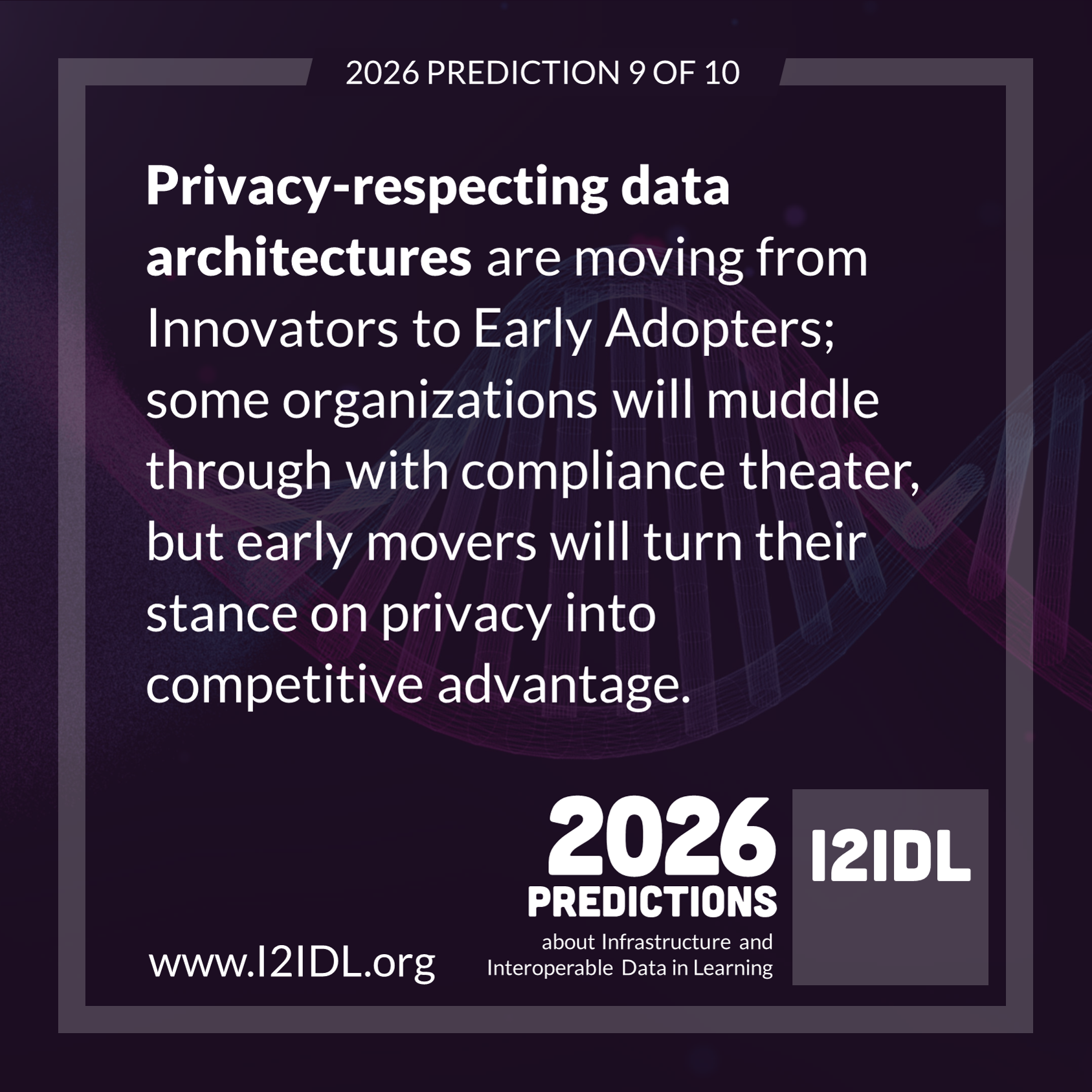
Continuing on I2IDL’s top ten predictions for learning technologies and data infrastructure in 2026, our ninth prediction is that government, higher-education, and workforce communities will increasingly demand data privacy solutions. Full-scale adoption will eventually follow, but architectural decisions are locking in now.
(ICYMI, check out Prediction #8 about verifiable credentials.)
Confidence Level: 4/5 ★★★★☆
Regulatory pressure on learning data is real and growing: GDPR enforcement continues to tighten, FERPA guidance is becoming more specific, the EU AI Act classifies educational AI systems as “high-risk,” and U.S. state-level privacy laws are proliferating.
At the same time, organizations want richer learning analytics: analyzing learner behavior across AI tutors, simulations, and adaptive pathways; tracking skill development longitudinally; correlating learning activities with performance outcomes. These ambitions increasingly conflict with privacy constraints that limit data collection, retention, and cross-system sharing.
The most likely outcome in 2026 isn’t resolution. Instead, we expect the market to segment into three camps. Many vendors and organizations will perform “compliance theater,” using superficial anonymization, vague consent flows, and checkbox compliance sufficient to satisfy auditors without meaningful protection. More risk-adverse organizations will respond by collecting less data or avoiding advanced analytics entirely. However, a smaller but growing segment will pursue genuine privacy innovation, positioning privacy-respecting architecture as a competitive differentiator.
Emerging approaches offer a path forward. Self-Sovereign Identity (SSI) promises to give learners direct control over their credentials and learning records, and initiatives from T3 Innovation Network, Digital Credentials Consortium and the EU Digital Identity Wallet are connecting SSI with learner records in practice. Relatedly, complementary frameworks such as A4L’s Global Education Privacy Standard (GEPS), piloted with the Jobs and Employment Exchange (JEDx), demonstrate how U.S. federal, state, and contractual privacy obligations can be integrated into software-enforceable rules.
But SSI still faces practical barriers. Interoperability remains fragmented across wallet providers and Distributed Identifier (DID) methods. Technical learning curves are steep for non-specialist users unfamiliar with private keys and decentralized credentials. Status-quo business incentives create inertia; identity verification is a profitable business, and incumbents have little motivation to disrupt themselves. And credential recovery (what happens when someone loses access to their wallet) remains unsolved at scale, with no equivalent to "forgot your password."
Where does this place SSI on the technology adoption curve? We're at the tail end of the Innovators phase (~3%), transitioning into Early Adopters. Policy mandates are creating the external pressure needed to cross that threshold in 2026, particularly in workforce development, higher education, and EU government services. But the Early Majority, where SSI becomes a default enterprise assumption rather than a deliberate innovation choice, is unlikely before 2028–2030.
So what? For organizations in policy-driven sectors, the timeline may be shorter than you think. For instance, if your programs touch Medicaid verification, ECCA-funded scholarships, or EU credentialing, start building SSI literacy now. For enterprise HR, the pressure is less immediate, but monitoring Early Adopter implementations will help you avoid costly pivots later. For vendors and the standards community, the Early Adopter phase is when architectural decisions get locked in. Build interoperable, standards-aligned solutions now. If open standards don’t demonstrate value in the policy-driven pilots of 2026–2027, proprietary platforms will fill the gap and be harder to displace.