Building the I2IDL Glossary Of Digital Learning as Infrastructure
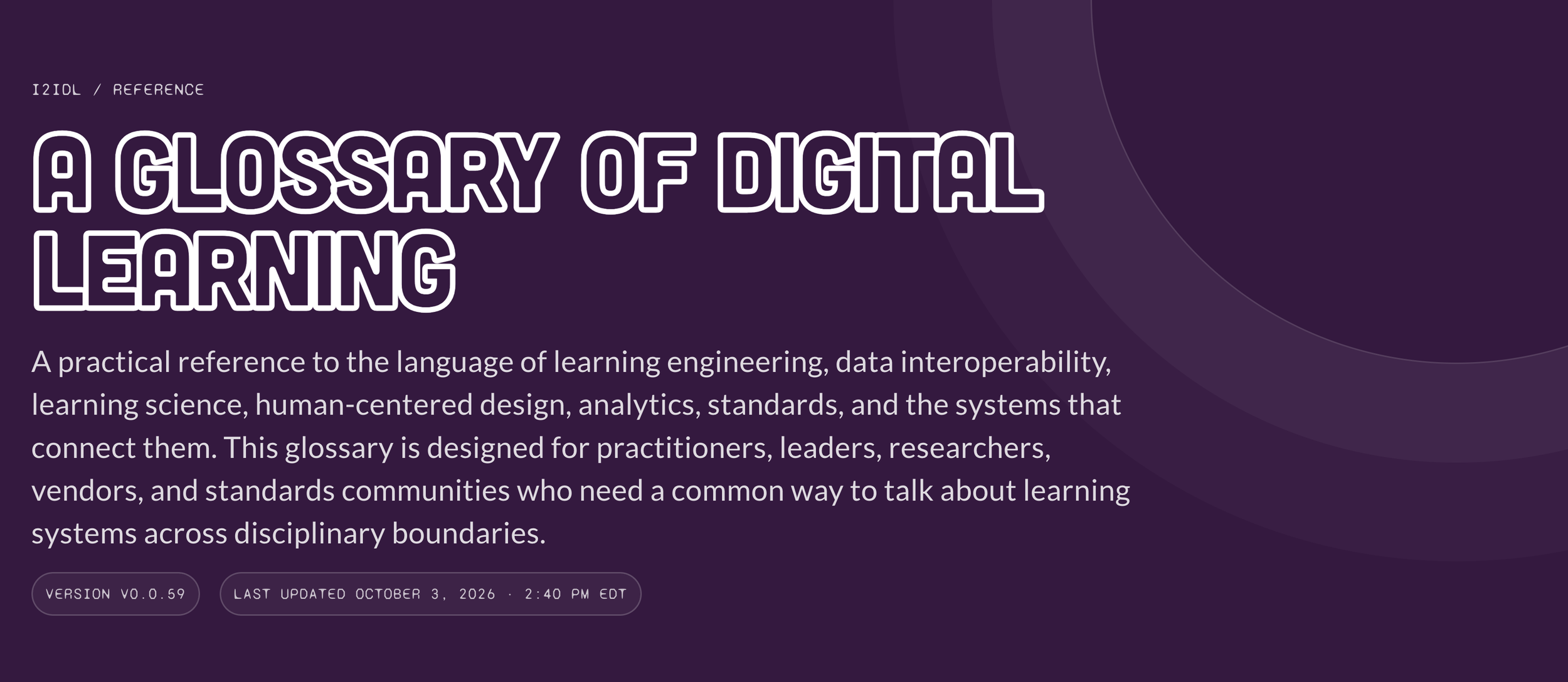
The I2IDL Digital Learning Glossary has grown from a reference page into a structured Linked Data resource.
Each concept now has a stable identity, source provenance, machine-readable JSON-LD and Turtle representations, and a place within a queryable semantic model.
Not Your Ordinary Glossary
When I2IDL began work on the Digital Learning Glossary, the immediate goal was to create a useful reference for the language that has accumulated across digital learning, learning engineering, interoperability, educational technology, data, simulation, artificial intelligence, and adjacent fields. The field has no shortage of terms. What it lacks is a common place where those terms can be understood in context, traced to their sources, and connected across domains. And then there was the whole matter of machine-readability.
The Glossary of Digital Learning has become an experiment in what a digital reference work can look like when the content, the evidence behind it, and the technical structure receive equal attention.
The public glossary contains hundreds of concepts drawn from standards, research, technical specifications, public reports, and I2IDL editorial work. Current sources include the Learning Engineering Body of Knowledge, IEEE standards and working groups, UNESCO, the World Bank, and many more. Topics are relevant to research on learning engineering, learning ecosystems, learning experience design, and educational technology.
Each entry contains a definition and an editorial explanation of why the concept matters. Entries carry filtering fields that help readers move through the collection. Source citations remain attached to the concepts they support. Licensing information stays connected to material that comes from third-party sources.
That part of the project resembles a conventional glossary. The architecture beneath it has taken the project in another direction.
Treating concepts as data
A term in the I2IDL glossary has its own persistent identity. For example, the concept “A/B testing” has the identifier: https://id.i2idl.org/concepts/a-b-testing. That URI identifies the concept across systems and publications. The card displayed on the I2IDL website is one representation of that concept.
The same record can be retrieved as JSON-LD: https://id.i2idl.org/concepts/a-b-testing.jsonld. And it can be retrieved as RDF expressed in Turtle: https://id.i2idl.org/concepts/a-b-testing.ttl. The canonical URI can be copied from the glossary card and used in another dataset, application, publication, or knowledge graph.
Every concept card in the glossary exposes these capabilities through three controls: JSON-LD, Turtle, and Copy URI. New concepts inherit the same structure when they enter the glossary.
That small row of links changes the nature of the reference work. A person can read an entry. A software system can consume the same concept as structured data.
A semantic model beneath the page
The glossary is built around a semantic model in which concepts, definitions, sources, evidence, classifications, and relationships have separate identities.
A concept can have a preferred label, alternative labels, a definition, an editorial explanation, field and type classifications, source evidence, and relationships to other concepts. Definitions exist as first-class records with provenance rather than as strings embedded in a web page. Source records can carry citation and licensing information. Collections can organize concepts without forcing the entire glossary into one hierarchy.
The model uses established standards. SKOS provides the vocabulary for concepts, concept schemes, labels, definitions, and semantic relationships. Schema.org supplies `DefinedTerm` and `DefinedTermSet`. Dublin Core Terms supplies metadata properties. PROV-O supports provenance. JSON-LD provides an interchange format for the graph.
The result is a glossary whose underlying data can move beyond the page where a reader encounters it.
This matters in a field built around interoperability. We spend a great deal of time discussing standards, data portability, machine-readable information, learning records, metadata, artificial intelligence, and semantic systems. A glossary about those subjects should benefit from the same principles.
Evidence stays with the definition
One of the concerns behind the project has been provenance.
Definitions in technical fields tend to travel. A definition begins in a standard, report, research paper, working group, or technical community. It gets copied into presentations, documentation, procurement language, product material, training material, and AI systems. Over time, the connection between the definition and its source can disappear.
The I2IDL model keeps source evidence as part of the record. A definition can point back to the material that supports it. That source can carry page information, publication information, a URL, a relationship type, and licensing information.
This creates a path from the short definition shown to a reader back to the evidence behind it.
That becomes useful when terms cross communities. “Profile,” “competency,” “learning record,” “simulation,” “interoperability,” and “learner model” can carry different assumptions depending on the standards community, research tradition, product environment, or institutional setting in which they appear. Provenance gives readers and systems a way to understand where a definition came from.
A glossary that can be queried
We have taken another step by publishing the glossary as a queryable RDF dataset. The Linked Data service lives at: https://id.i2idl.org/ and the complete glossary is available as JSON-LD at: https://id.i2idl.org/glossary.jsonld.
I2IDL has a read-only SPARQL endpoint at: https://id.i2idl.org/sparql. SPARQL is a query language for RDF data. It allows a researcher, developer, or application to ask questions of the glossary as a graph.
A query can retrieve concepts associated with a field. It can examine definitions and their provenance. It can follow relationships among concepts. It can inspect source records or identify concepts belonging to a particular collection.
This gives the glossary uses that extend beyond browsing alphabetical cards on a website. A research tool can query it, whereas a terminology service or reference publisher can consume it. A knowledge graph can reference its identifiers. An AI system can use its structured records as grounded terminology. Another organization can link its own concepts to I2IDL concepts without copying the entire glossary into its system.
The human interface remains important
None of this reduces the importance of the public glossary. Most people who visit the page will search for a term, read a definition, follow a citation, or browse a field. They do not need to know what RDF, JSON-LD, SKOS, or SPARQL are. Rather, the technical architecture exists so that the same work readable by humans can support other forms of use without requiring a second glossary.
The search interface, filters, source links, alphabetical navigation, concept cards, and Concept of the Day are generated from the same structured body of content that supports the Linked Data service. The public page and the machine-readable graph are two views into the same reference work. That relationship has become one of the most interesting parts of the project.
Why this matters
Digital learning has accumulated decades of terminology from education, software engineering, instructional design, data science, simulation, artificial intelligence, workforce development, psychology, standards development, and institutional practice. These communities share language, borrow language from one another, and use the same words in different ways.
A digital glossary cannot resolve every disagreement about terminology. But it can make definitions traceable. It can give concepts persistent identities and it can expose relationships. It provides a way to preserve evidence and can give people and machines access to the same body of knowledge. Those properties become more important as AI systems take a larger role in search, synthesis, analysis, and knowledge work. If we want machines to work with the language of a field, giving those machines structured concepts, source evidence, provenance, and stable identifiers is a useful place to start.
The I2IDL Digital Learning Glossary remains a growing reference. New sources will enter it and new concepts will appear. The relationships among concepts will expand and the definitions will evolve as standards and practice change. The infrastructure gives us a way to manage that change while preserving the identity and history of the concepts themselves. And that seems like a fitting approach for a glossary about digital learning.
